

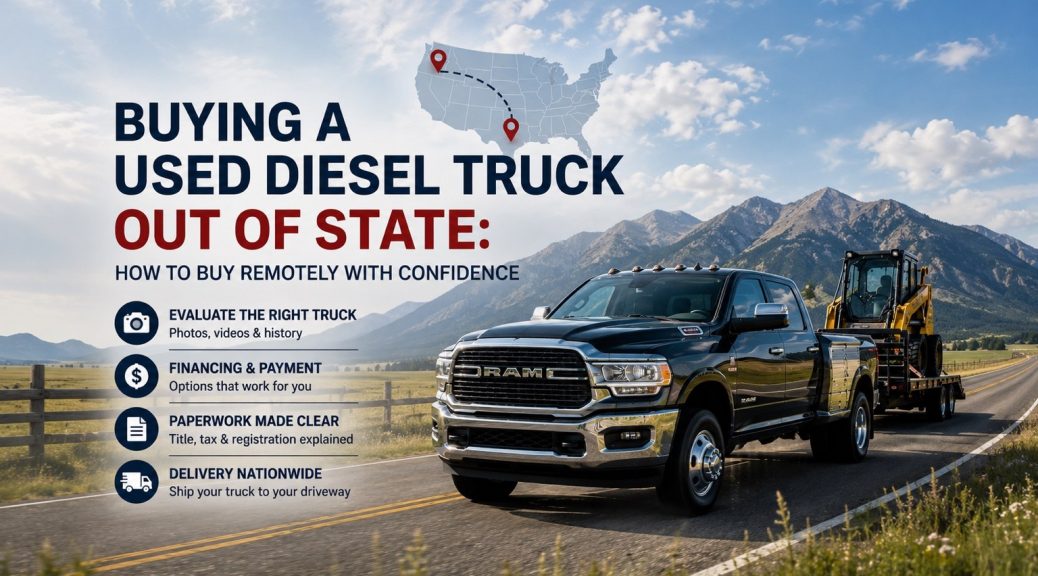
Finding the right used diesel truck does not always mean finding one close to home.
The exact combination you want—Ford Super Duty, Ram HD, Chevrolet Silverado HD or GMC Sierra HD; the right diesel engine; the right trim; 4×4; bed length; mileage; condition; equipment and price—may be hundreds or even thousands of miles away.
That creates a different kind of buying decision.
Instead of simply asking, “Is this the right truck?” an out-of-state buyer also has to ask:
“How can I confidently evaluate, finance, purchase and receive a used diesel truck when I cannot simply drive across town to see it?”
Buying remotely does require more diligence. But distance itself does not have to make the transaction unusually complicated or risky. The key is having enough information about the specific truck, understanding the transaction before committing to it, and knowing how the vehicle will get from the dealership to you.
At North Texas Truck Stop in Mansfield, Texas, we work with diesel-truck shoppers well beyond the Dallas-Fort Worth area. This guide explains what an out-of-state buyer should consider from the moment a truck catches their attention through the day it arrives.
Why Shop for a Used Diesel Truck Outside Your Local Market?
For many vehicles, shopping locally may give you plenty of choices. Used heavy-duty diesel trucks can be different.
A buyer may be looking for a very specific combination:
- A particular Power Stroke, Cummins or Duramax generation
- F-250, F-350, Ram 2500, Ram 3500, Silverado 2500HD or 3500HD, or Sierra 2500HD or 3500HD
- Single-rear-wheel or dual-rear-wheel configuration
- 4×4
- Long bed or standard bed
- Specific trim and equipment
- Acceptable mileage and ownership history
- Condition appropriate for the price
- A truck that has not been poorly modified or neglected
Restricting the search to a small geographic radius can dramatically reduce the number of trucks that meet those requirements.
That is the fundamental advantage of shopping nationally: you can search for the right truck instead of settling for the closest truck.
If you are beginning that search, you can browse our current used diesel truck inventory and compare available trucks before deciding whether traveling to Texas or purchasing remotely makes sense.
Step 1: Evaluate the Specific Truck, Not Just the Listing
This is the most important part of buying remotely.
A model year, trim level, engine reputation and attractive price can help identify a candidate. None of those things tells you the complete condition of the individual truck.
Used diesel trucks have histories.
Some accumulated mileage primarily on the highway. Others spent years towing. Some were work trucks. Some were personal vehicles. Maintenance may have been excellent, average or neglected. Modifications may have been thoughtful, questionable or somewhere in between.
When you cannot initially inspect the truck yourself, the quality of the vehicle-specific information becomes even more important.
A remote buyer should look for evidence that helps answer questions such as:
- What does the truck actually look like today?
- Are there visible signs of wear or damage?
- What does the interior condition suggest about prior use?
- What does the vehicle-history information show?
- Does the truck appear substantially stock or modified?
- What maintenance or reconditioning has been performed?
- Are there concerns that need to be discussed before moving forward?
That is also why we recommend evaluating a used diesel as a complete vehicle rather than relying on the reputation of its engine. Our guide to how we evaluate used diesel trucks and what buyers should look for goes deeper into the mechanical and condition-related questions that matter when considering an individual truck.
Step 2: Use Photos and Video to Reduce the Distance
Photos are essential when shopping remotely, but a photo gallery and an in-person walkaround are not exactly the same experience.
Video can help close some of that gap.
A walkaround can provide additional context about exterior appearance, stance, wheels and tires, body condition, interior layout and the overall presentation of the truck. It also gives a distant shopper another way to examine the specific vehicle rather than relying entirely on written specifications.
North Texas Truck Stop provides vehicle walkaround videos, and you can view our current truck walkarounds while researching inventory.
For a remote purchase, use all of the available evidence together. Photos, video, vehicle history, specifications, descriptions and direct answers from the dealership each tell part of the story.
No single one should be treated as a substitute for the others.
Step 3: Understand What the Vehicle-History Report Can—and Cannot—Tell You
A vehicle-history report can be particularly useful when the truck is far away because it provides another source of information about the vehicle’s past.
Depending on the available record, that may include ownership history, reported accidents or damage, title information, service records, registration history and other events associated with the VIN.
But a history report should be treated as one piece of the evaluation, not a complete inspection of the truck.
A clean history report does not automatically mean a vehicle is mechanically perfect. Likewise, an entry on a history report should be understood in context rather than automatically interpreted as proof that the truck is a poor purchase.
The useful question is:
Does the history of this particular truck make sense when considered alongside its present condition, maintenance evidence, mileage, prior use and price?
When shopping remotely, ask about anything in the vehicle history that you do not understand before committing to the purchase.
Step 4: Understand How the Truck Was Prepared for Sale
Condition at the time of sale matters whether you live five miles away or five states away. For a remote buyer, however, understanding what happened between acquisition and retail sale becomes especially valuable.
A used truck dealership is not manufacturing a new vehicle. Every truck begins with its own mileage, history and existing condition. The relevant question is how the dealership evaluates that vehicle and what preparation occurs before it is offered for sale.
At North Texas Truck Stop, our process is explained in more detail in The NTTS Reconditioning Standard.
For an out-of-state shopper, this is useful context because it helps distinguish two different questions:
- What was this truck’s prior history?
- What is its condition now?
Both matter.
Step 5: Ask Questions About the Actual Truck Before You Buy
Remote buying works best when communication becomes more specific, not less.
Do not hesitate to ask questions simply because the answers are not obvious from the listing.
If a particular scratch, seat condition, tire, feature, modification, history-report entry or mechanical concern matters to you, ask about it.
The objective is not to eliminate every uncertainty that comes with buying a used vehicle. That is unrealistic even when buying locally.
The objective is to identify the information that could materially affect your purchase decision before the transaction is completed.
You can contact North Texas Truck Stop when you have questions about a particular vehicle or the remote-purchase process.
Step 6: Look for Evidence of Dealership Reputation
When buying locally, you can walk into a dealership, meet the people involved and develop an impression firsthand.
A remote buyer has to establish trust differently.
Before sending money or signing paperwork with any dealership, look beyond the advertisement for evidence of an established business and a history of actual customer transactions.
That can include:
- Customer reviews
- How long the dealership has operated
- Consistency of business identity and contact information
- Quality and specificity of vehicle listings
- Direct communication with dealership personnel
- Clear answers about the truck and transaction
You can read North Texas Truck Stop customer reviews as part of your own evaluation of the dealership before purchasing.
Step 7: Work Out Financing Before the Truck Starts Moving
Financing an out-of-state purchase does not change the fundamental lending questions: vehicle price, down payment, credit profile, loan term, interest rate and lender requirements still matter.
What changes is the logistics surrounding the transaction.
Before arranging transportation, make sure you understand how the vehicle will be paid for, what documentation is required and what must occur before the truck can be released.
It is easy to focus on the monthly payment, but a remote buyer should still evaluate the complete transaction. Our article on how smart diesel truck buyers approach financing explains the broader financing considerations in more detail.
If you are ready to discuss financing for a specific truck, you can also learn about diesel truck financing at North Texas Truck Stop.
Step 8: Understand the Paperwork for an Out-of-State Vehicle Purchase
This is one area where buyers should be cautious about one-size-fits-all internet advice.
An out-of-state vehicle transaction can involve purchase documents, lender requirements where financing is involved, title documentation, taxes, registration requirements, signatures and other state-specific considerations.
The exact process can vary based on the transaction and where the buyer lives.
That means an article like this should not tell every buyer that the paperwork will happen in exactly the same sequence or that every state handles taxes, title and registration identically.
Instead, before completing your purchase, make sure you understand:
- Which documents you will need to sign
- How those documents will be completed or returned
- How payment or lender funding will be handled
- What title documentation will accompany or follow the transaction
- Which taxes and fees apply to your specific purchase
- What you will need to complete registration in your home state
- What must be completed before the truck can be released for pickup or transport
If anything is unclear, ask before signing or sending funds.
For transaction-specific questions, contact us directly so the process can be explained for the truck and transaction you are considering.
Step 9: Decide Whether You Want to Travel or Have the Truck Shipped
Buying out of state does not necessarily mean shipping the truck.
Some buyers prefer to travel to the dealership, see the truck themselves and drive it home. Others may decide that transportation is more practical because of distance, schedule or travel costs.
Neither approach is universally better.
If you decide to have the truck transported, shipping becomes the final logistical stage of a much larger buying process—not the basis for deciding whether the truck itself is right for you.
Vehicle transport can vary based on factors such as distance, truck size, route, carrier availability, timing and delivery requirements.
North Texas Truck Stop can help coordinate transportation for buyers who need it. Our nationwide truck shipping and delivery page explains the transport process, cost factors, carrier coordination and what buyers should expect when having a truck delivered.
Step 10: Think About Protection After the Sale
A used diesel truck is a complex vehicle, and buying remotely does not change the importance of understanding what protection—if any—applies after purchase.
Do not assume that every used truck, every component or every service contract has identical coverage.
If warranty or vehicle-protection options are important to your decision, review the terms that apply to the particular truck and transaction. Coverage, exclusions, eligibility, deductibles and other conditions can vary.
You can learn more about available warranty and vehicle-protection information, and you should confirm the specific terms applicable to the vehicle you are considering.
Is It Safe to Buy a Used Diesel Truck Without Seeing It in Person?
There is no responsible way to say that every remote vehicle purchase is automatically safe simply because it happens through a dealership.
The better answer is that risk can be reduced through evidence, verification and communication.
Before purchasing a used diesel truck remotely, you should be comfortable with:
- The identity of the dealership
- The identity and specifications of the vehicle
- The truck’s photos and available video
- The available vehicle-history information
- The truck’s disclosed condition
- Answers to your vehicle-specific questions
- The purchase price and transaction terms
- The financing arrangement, if applicable
- The paperwork process
- How and when funds will be transferred
- How the truck will be picked up or delivered
- Any warranty or protection terms important to your decision
If you are not comfortable with an important part of the transaction, resolve it before proceeding.
Distance should not be used as a reason to lower your standards.
Should You Get an Independent Inspection?
For some remote buyers, an independent inspection may provide additional confidence—particularly when there is a specific concern, the truck represents a substantial purchase, or the buyer wants another assessment before committing.
Whether that makes sense is a personal decision based on the vehicle, the available evidence and your own comfort level.
An inspection also should not be confused with a guarantee against future repairs. Used vehicles contain wear components and complex mechanical systems, and no inspection can predict every future failure.
Its value is in giving the buyer another source of information about the truck’s condition at the time it is evaluated.
What Should You Ask Before Buying a Diesel Truck From Another State?
A useful remote-purchase checklist includes:
- Is the truck still available?
- Does the listing accurately represent its current equipment and condition?
- Can I review the available vehicle-history information?
- Is there a walkaround video of this specific truck?
- Are there cosmetic or mechanical concerns I should know about?
- Has the truck been modified?
- What preparation or reconditioning has been completed?
- What is the complete purchase price and what fees apply?
- How will financing or payment be handled?
- How will purchase documents be completed?
- What should I expect regarding title, tax and registration for my state?
- When can the vehicle be released?
- If I want delivery, how will transportation be arranged?
- What warranty or protection terms apply to this specific truck?
The answers should leave you understanding both the truck and the transaction.
Common Mistakes When Buying a Used Diesel Truck Remotely
Choosing by Price Alone
The cheapest comparable truck is not automatically the least expensive truck to own.
Condition, maintenance history, prior use, modifications and deferred repairs can matter considerably more than a small difference in advertised price.
Choosing by Engine Reputation Alone
A desirable Power Stroke, Cummins or Duramax generation can still be attached to a poorly maintained truck.
Buy the entire vehicle, not an engine reputation.
Assuming Low Mileage Guarantees Better Condition
Mileage needs context. Highway use, short trips, idle time, maintenance, towing, age and prior use all contribute to the story.
Waiting Until After the Purchase to Ask Condition Questions
If something matters to you, ask about it before committing.
Treating Shipping as the Hard Part
Transportation is important, but moving the truck is usually not the most important buying decision.
The difficult part is making sure you have selected the right truck and understand the transaction. Once that is settled, delivery is a logistics problem.
Assuming Paperwork Works the Same Everywhere
State requirements can differ. Confirm the process applicable to your transaction rather than relying on generic advice from another buyer in another state.
Buying Locally vs. Shopping Nationally for a Used Diesel Truck
Buying locally has obvious advantages. You can see the truck easily, test-drive it and avoid long-distance transportation.
But local convenience should be weighed against selection.
If your local market has exactly the truck you want in the right condition at the right price, there may be little reason to expand the search.
If it does not, shopping nationally gives you a larger pool of vehicles from which to choose.
For specialized used diesel trucks, that can be meaningful. A buyer looking for a particular one-ton configuration, long-bed truck, trim, drivetrain or diesel generation may find that the right vehicle simply is not sitting within 25 miles of home.
The goal is not to buy far away for the sake of buying far away.
The goal is to avoid allowing geography to eliminate the right truck before you have evaluated it.
How a Remote Used Diesel Truck Purchase Fits Together
The complete process is easier to understand when viewed as a sequence:
- Find a truck that genuinely fits your requirements.
- Study the listing, photos, specifications and available video.
- Review the available history and condition evidence.
- Ask questions about anything that could affect your decision.
- Understand the dealership and who you are doing business with.
- Agree on price and understand the complete transaction.
- Arrange financing or payment.
- Complete the required paperwork.
- Confirm any applicable warranty or protection terms.
- Travel to collect the truck or arrange transportation.
- Complete the title and registration requirements applicable in your home state.
Seen this way, shipping is only one piece of the process.
The real objective is confidence at each step.
Final Take: Buy the Right Truck, Even If It Isn’t Close to Home
A used diesel truck is a significant purchase. There is nothing wrong with preferring to buy one locally.
But there is also no reason to assume the best truck for you must be the closest truck to you.
For an out-of-state buyer, the smartest approach is to separate the decision into two questions:
First: Is this particular truck the right vehicle?
Evaluate its configuration, history, condition, maintenance, prior use, available evidence and price.
Second: Am I comfortable with the transaction required to buy it remotely?
Understand the dealership, financing or payment, paperwork, applicable protection and how the truck will reach you.
If both answers are yes, distance becomes a logistics issue rather than a reason to settle for a different truck.
You can shop our current used diesel trucks, review the available vehicle information and contact North Texas Truck Stop with questions about a specific truck or purchasing from outside Texas.
North Texas Truck Stop
Mansfield, Texas
Call (877) 355-5008
Shop Used Diesel Trucks | Diesel Truck Financing | Nationwide Truck Shipping & Delivery